SRL Archive - Mathematics

This problem is bugging me...


Overtime

2011-07-24 16:59:36

sqrt(t-42)-sqrt(t+44)=83

I know the problem looks like this.

sqrt(t-42)=83+sqrt(t+44)

and then you square both sides

but im having a problem doing that :X

I know the formula is this (a-b)^2=a^2-2ab+b^2

and then i write it in ax^2 +bx +c = 0

If someone can just help me out with squareing both sides that would be great. im not sure my numbers are right as they are rather big.

Plz help, already tried google and looked through the book, just not the examples im looking for…


Coh3n

2011-07-24 17:15:16

Square each term. So you end up with (t - 42)^2 - (t + 44)^2 = 83^2. I think that's right. Either that or I just completely fail.

Brandon

2011-07-24 17:25:44

^ Thats right.. but u can also change the square root to a fraction like (t-42) ^ (1/2) then u square that.. and u get the cancellation

Coh3n

2011-07-24 17:29:26

Oh wait, no I wasn't right, you end up with (t - 42) - (t + 44) = 83^2 cause the sqrt and ^2 cancel out. My bad.

Overtime

2011-07-24 17:34:44

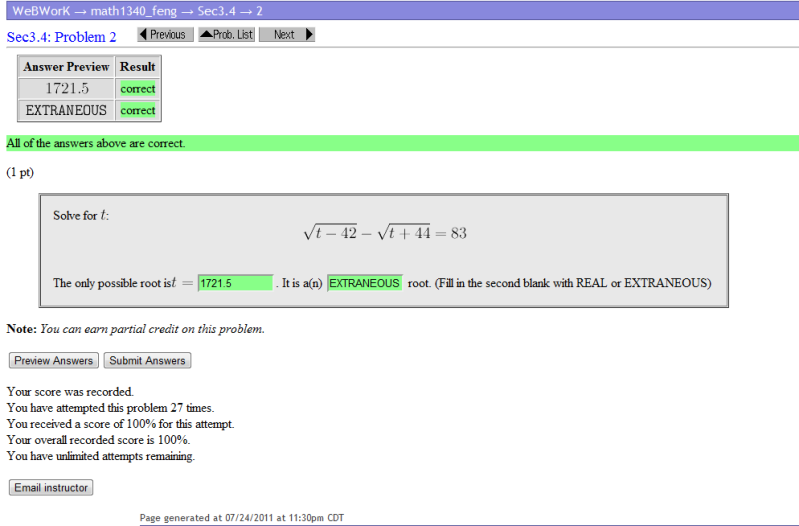
this is the problem:


Edit: @cohen

Yea that wouldnt work.

I was tought to move one of the square roots over. and then square the left and the right.

Thats where im stuck at.

Coh3n

2011-07-24 17:42:39

Yeah the way I work it out the t's cancel each other out, so it doesn't make sense.

Overtime

2011-07-24 17:46:29

Okay, i think i almost got it.

I ended up with this:

t-42=6889+166sqrt(t+44)+t+44

then.

6889+166sqrt(t+44)+86

Can anyone confirm that I'm at least on the right trail?

Markus

2011-07-24 17:47:14

Lolfailalgebra.
sqrt(t-42)-sqrt(t+44)=83
(sqrt(t-42)-sqrt(t+44))^2 = 83^2
(sqrt(t-42)-sqrt(t+44))(sqrt(t-42)-sqrt(t+44)) = 6889
sqrt^2(t-42)-2*sqrt(t-42)*sqrt(t+44)+sqrt^2(t+44)) = 6889
t-42+t+44 -2*sqrt(t-42)sqrt(t+44) = 6889
+2-2*sqrt(t-42)sqrt(t+44)=6889
-2*sqrt(t-42)sqrt(t+44) =6887
2*sqrt(t-42)*sqrt(t+44)=-6887
So I just made a mistake and it all fails. 2* square roots cant be negative bro.

Edit: Wait I can just prove this.
sqrt(t-42)-sqrt(t+44) < 0
Because, sqrt(t-42) < sqrt(t+44)
t-42 < t+44

No solution possible, because left side is negative and thus will never ever equal 83 without imaginary numbers.

masterBB

2011-07-24 17:48:33

This one got no answer. It is impossible.

you can prove: sqrt(t-42) < sqrt(t+44)

So the answer would be negative. 83 is not possible.

Markus

2011-07-24 17:50:42

^ ninja'd ;)

masterBB

2011-07-24 17:54:17

From: Markus
^ ninja'd ;)


I hate you! Didn't had maths in 2 years. Had to search for all algebra rules again in the dusty old rooms of my brain. First I was on the same track as coh3n, then had an eureka moment, knowing the answer. Checked if no one else posted it yet, typed it, pressed enter. Felt like 'the' man. And then I see your comment…

Overtime

2011-07-24 18:00:35

Its solveable with imaginary numbers….

Just need help with completing the square…


BazzBarrett

2011-07-24 19:01:31

ummm… ur all looking at this wrong
remember there is a + and - answer to all square roots
so move the root t + 44 across and square gives
tidy this up gives

no matter what this gives the answer t = 1765.5

now put this in and you will find it works if the second sqrt is negative only. so there is a solution


isnt there a maths teacher on these forums..

masterBB

2011-07-24 19:09:05

But as Overtime posted it there was no +/- sign, so wouldn't that be a principal square root?

Overtime

2011-07-24 20:13:24

That answer is incorrect even if i tried rounding it off.

Tomorrow Im meeting my math tutor before class.

He is suprised that this was one of my homework questions. and i will let you guys know the answer.

But if ya'll know it before he does, post it!

Tlachtli

2011-07-24 21:24:56

Well, the TI-89 seems to think this is an impossible problem. No real solutions, no nonreal/i-term solutions.

The farthest I can get it by hand is:

sqrt(t - 42) - sqrt(t + 44) = 83
sqrt(t - 42) = 83 + sqrt(t + 44)
t - 42 = 166*sqrt(t + 44) + t + 6933
-6975/166 = sqrt(t + 44)

Unless I'm being terribad at math, this suggests that t=i*47438161/27556
In decimals, t=1721.518*i
However, when plugged into the original equation this is untrue (you get -1.036 = 83)

Overtime

2011-07-25 00:31:27

Woot Tlachtli is right.

Can you explain some of your math plZ?!?!?! :D

Its only 1721.5

no i


TRiLeZ

2011-07-25 01:21:24

This is how you solve this equation:
  • Isolate one root
  • Square both sides
  • Simplify
  • Isolate the remaining root
  • Square both sides
  • Move the constants to one side

The answer I got down to the last decimal is: 1721.517707 = t.

Tlachtli

2011-07-25 02:08:00

From: Overtime
Its only 1721.5

no i


:duh: Square both sides again, negative goes away. No i. I should have thought about that earlier.

Anyways, I think its interesting that the calculator can't come up with a solution for this one.

Coh3n

2011-07-25 08:09:48

From: Tlachtli
Anyways, I think its interesting that the calculator can't come up with a solution for this one.
Because there is no real solution. Would just like point out that I said that, just in a different way. :p After you square each term + collect like terms, there aren't any t's left. >.<

masterBB

2011-07-25 08:19:10

From: Coh3n
Because there is no real solution. Would just like point out that I said that, just in a different way. :p After you square each term + collect like terms, there aren't any t's left. >.<


As mentioned before, there is a solution. I just don't agree with the notation, that is the symbol of a principal square root and not a square root…

Coh3n

2011-07-25 08:23:01

From: masterBB
As mentioned before, there is a solution. I just don't agree with the notation, that is the symbol of a principal square root and not a square root…

I said there's no real solution… you and Markus said the same thing. What an I missing?

masterBB

2011-07-25 08:34:06

That it's not a principal square, it also returns negative. It has an answer.

And your maths are off anyway, if you use your math rules, this would have worked:

sqrt(9) + sqrt(4) = 5 -> 3 + 2 = 5
9 + 4 = 5^2 -> 13 doesn't equal 25, this ain't right.

Coh3n

2011-07-25 08:53:02

From: masterBB
That it's not a principal square, it also returns negative. It has an answer.

And your maths are off anyway, if you use your math rules, this would have worked:

sqrt(9) + sqrt(4) = 5 -> 3 + 2 = 5
9 + 4 = 5^2 -> 13 doesn't equal 25, this ain't right.
Heh good point. :p I should really brush up on my math…

KingKong

2011-07-25 08:53:27

From: masterBB
That it's not a principal square, it also returns negative. It has an answer.

And your maths are off anyway, if you use your math rules, this would have worked:

sqrt(9) + sqrt(4) = 5 -> 3 + 2 = 5
9 + 4 = 5^2 -> 13 doesn't equal 25, this ain't right.


mind telling me how u go from line 1 to line 2?

masterBB

2011-07-25 09:01:44

From: KingKong
mind telling me how u go from line 1 to line 2?


It was an reaction to this post:

From: Coh3n
Square each term. So you end up with (t - 42)^2 - (t + 44)^2 = 83^2. I think that's right. Either that or I just completely fail.


But it is against the math rules. Correct would be:

(sqrt(9)+sqrt(4))^2 = 5^2
(sqrt(9)+sqrt(4)(sqrt(9)+sqrt(4) = 25
9 + 2*(sqrt(9)*sqrt(4)) + 4 = 25
9 + 12 + 4 = 25

And that is how I square both sides.

Coh3n

2011-07-25 09:07:14

From: masterBB
But it is against the math rules. Correct would be:

(sqrt(9)+sqrt(4))^2 = 5^2
(sqrt(9)+sqrt(4)(sqrt(9)+sqrt(4) = 25
9 + 2*(sqrt(9)*sqrt(4)) + 4 = 25
9 + 12 + 4 = 25

And that is how I square both sides.
Yeah, you're right. :)