Before I comment, I must say I enjoyed reading your post yakman.
From: Yakman
With the scientific method, theories are set up so they are very easy to destroy if only the evidence came up.
To take evolution as an example of something that is very easy to disprove, all you need to do is find a single genuine fossil in the wrong period. A commonly cited example is a fossil rabbit in the precambrian. You could also try to find a single animal who's DNA does not fit into the known tree of life.
All it would take is a single example. And its never been found despite many people trying hard for over 100 years.
Actually this is quite true. Very well thought out point, but just because something has not YET happened, does not mean it can not happen. Realistically there is a probability of some sort for ANYTHING to happen. These things might not have been found (I might look it up in a little bit to see if your claim is correct), but that does not mean that they will never be found.
From: Yakman
Evolution is as proven as any theory in science. It often makes little sense to call it a theory in everyday language, people just say it's a fact. Its just as much of a fact as the fact that the earth is round, that all matter is made from atoms and that gravity keeps us on the ground.
Evolution is, like you said, a theory. Theory != Fact. People are led to believe that a theory is a fact, which is not correct. Also, your claims of the earth being round and gravity and atoms are all Matters of Fact, and not Relations of Ideas. Since matters of facts are not founded upon necessity, then you really can not call them "facts", but rather call them theories.
From: Yakman
I feel it would be dishonest for a science teacher to emphases that evolution isn't proven, to artificially cast doubt on it. (no doubt many interested parties would like it).
Very interesting opinion, and I took note of the word "artificially." By saying this word, I am assuming you believe that this theory is actually a fact that can not be unproven. If so, then obviously you would not want it to be presented with doubts attached. But, it has never been proven and it can never fully be proven; that is why it is called a theory. And science is supposed to be accepting of doubt. Without doubt of theories, then we would all still believe strongly in a flat world, and any other previous theories. Without doubt, we can not advance scientifically.
From: Yakman
Its probably more of a topic for a philosophy class, when students are introduced to the idea of nothing actually being proven.
"You know the earth could be flat, we haven't actually proved it is round"
"You know atoms might not be real"
"You know evolution might be wrong"
You are absolutely right: it is the topic of a philosophy class. But since we are debating about whether is there any proof for evolution, why not use sources other than the standard "science" classes? If one can not even prove that evolution could have the potential to being true through philosophy, then why even bother debating on the topic? Now, I am not saying it does not have to potential for being true, because it does, but all I am saying is that one should not discredit philosophy within debating realms.
From: Yakman
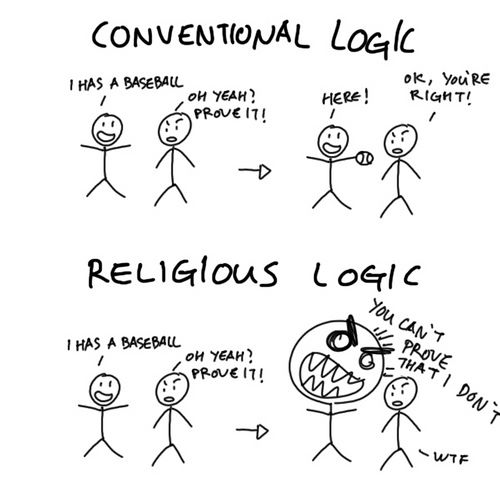
Religion, by contrast sets its postulates up so they are very difficult or impossible to disprove. Many are unfalseifiable. In fact history shows time and time again how when a new piece of knowledge is uncovered, religions change their view saying it was only a metaphore or that they were actually right all along. This dishonest shifting the goalposts should warn anybody against using religion as a path to knowledge.
Very interesting :) . Source?
From: Yakman
The scientific method of testing ideas against experiment is a real path to knowledge and understanding. Religious revelation is not.
You think like Galileo too! :D Just like GoF. (Well, Galileo might or might not agree with the last sentence, not sure, will do even more research on his life and continue study his works).
Also just for a little bit of fun, please prove your claim. :) Please prove to me that the scientific method is a real path to obtaining knowledge. All I see it as is a way to find probability. It gives no concrete answer to anything.